
Niskayuna City Directory Collections
Most useful Niskayuna historical directory material is part of the wider Schenectady-area run rather than a stand-alone Town series. The Schenectady Digital History holdings list identifies the early volumes, later continuity, missing editions, telephone books, and cross-reference runs. Read the geographic scope printed in each volume. A Schenectady title may include Niskayuna, while another edition may be limited to the city or include other county towns. That distinction matters when a person, street, or business does not appear.
| Collection | Years | Where held | Access |
|---|---|---|---|
| Schenectady-area city directories | 1841-42, 1857-58, then 1861-1968 with listed gaps | Schenectady Digital History and library resources | Online holdings guide and local research access |
| Digitized directory pages | 1841 and 1860 | Schenectady Digital History directory hub | Free online |
| Area directory volumes | 1980 and 1984 | House Histories Quick Research Guide holdings | Local historical research route |
| Telephone and cross-reference directories | Telephone books from 1961; cross-reference runs from 1967 and 1971 | Directory holdings list | Check holdings and format before use |
The main run is continuous from 1861 through 1968 except 1903, 1917, 1922, 1932, 1934, 1944, 1946, 1948, 1950, and 1967. The holdings list has no general volumes for 1968 through 2006. A blank year is a gap in this shelf, not proof that a household left Niskayuna.
Note: Record the edition year and geographic scope before comparing a directory entry with another historical source.
Niskayuna Directory Years and Gaps
The directory sequence changes the search strategy. The first listed volumes are 1841-42 and 1857-58, followed by the long 1861-1968 run. A nearby year can often test whether a missing name is caused by a move, a spelling change, or an unlisted edition. The digitized city-directory hub is the best starting point for the two online volumes, while the holdings page identifies what must be pursued through a library or archive.
The directory holdings page shows the collection and its gaps.
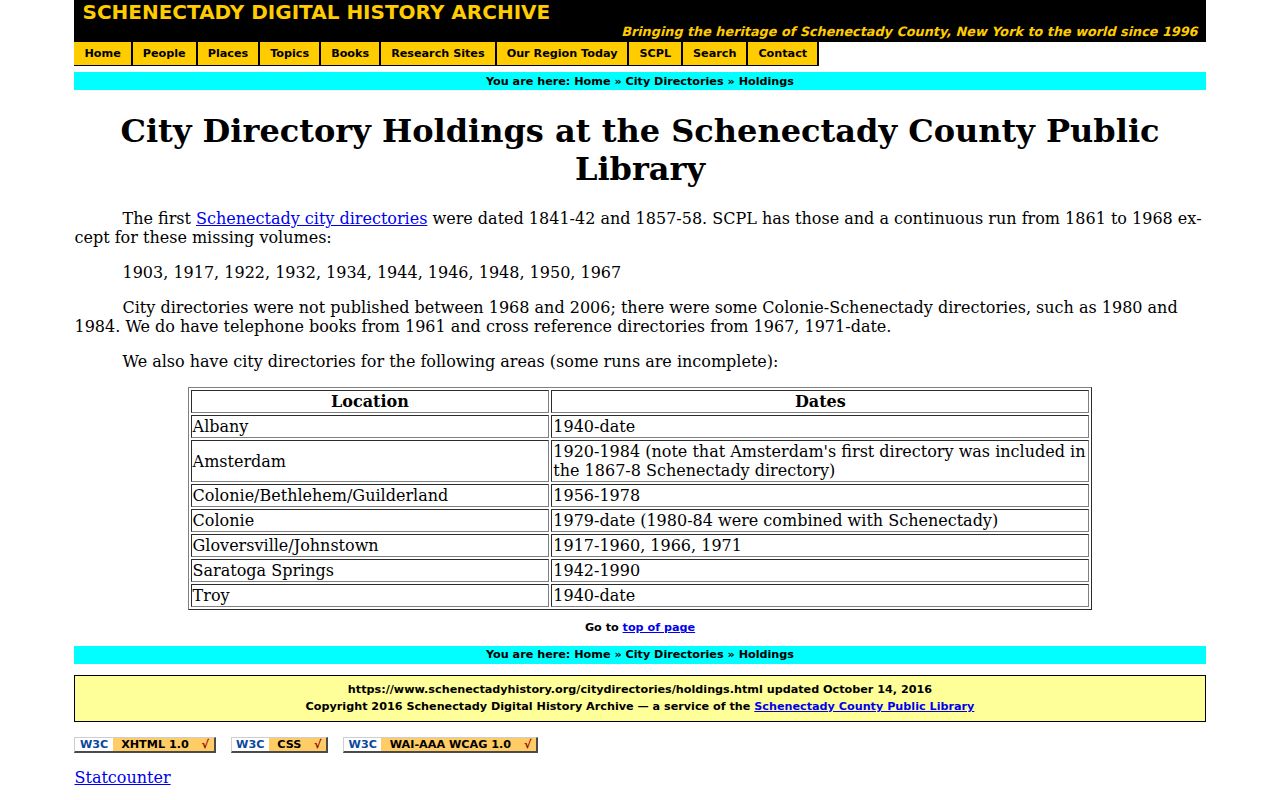
Use the displayed coverage as an inventory, then preserve the exact year in research notes. This prevents a later source from being mistaken for a missing city directory edition.
- 1841-42: first directory listed in the holdings.
- 1857-58: another early volume before the longer sequence.
- 1861-1968: broad run with ten identified missing years.
- 1968-2006: no general directory volume is listed.
Niskayuna Library City Directory Shelf
The Niskayuna Branch of the Schenectady County Public Library is a local starting point for in-person research. The branch is at 2400 Nott Street East and posts Monday and Wednesday hours of noon to 7 p.m.; Tuesday, Thursday, Friday, and Saturday hours are 10 a.m. to 5 p.m. The wider library history resources add county census microfilm from 1790-1930, area directories, yearbooks, newspapers, atlases, and research databases. A directory search can therefore move to another record type without losing the locality.
The Niskayuna Branch page provides current branch identity and public access details.
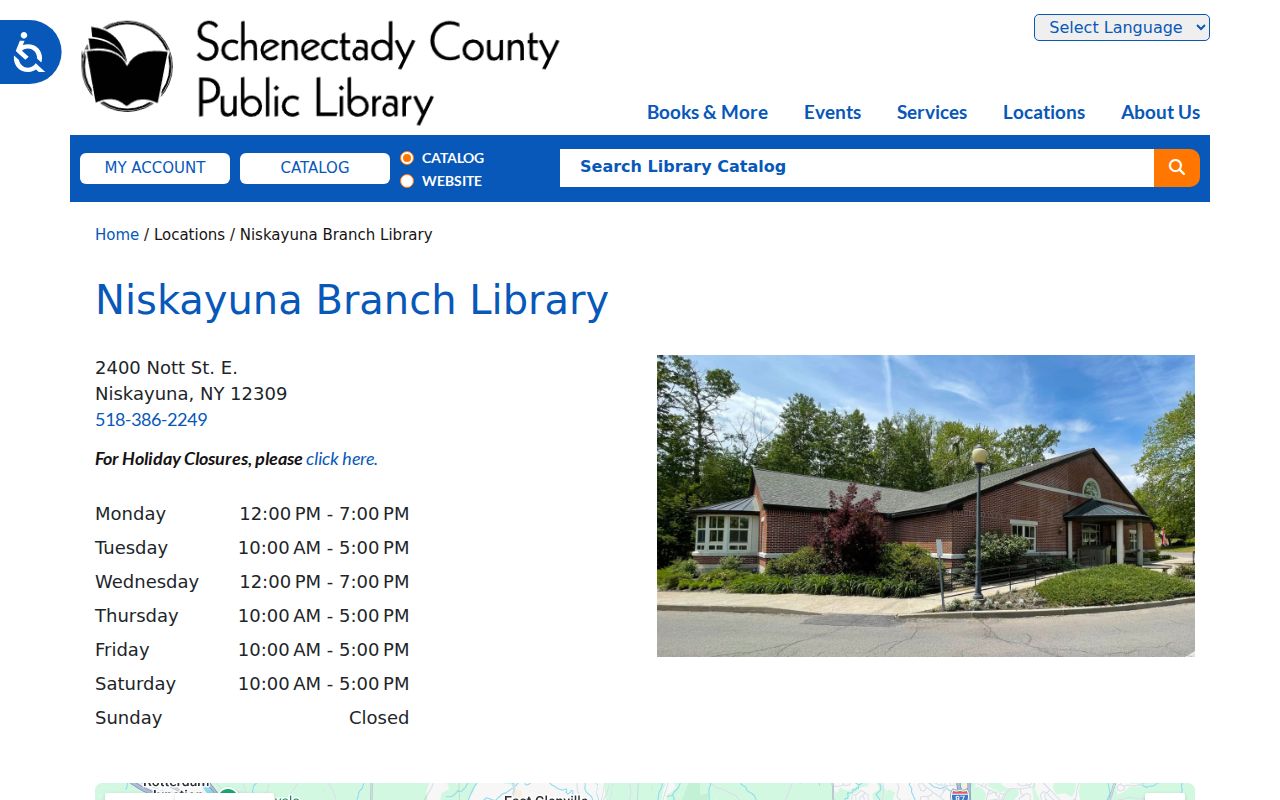
Confirm hours before a visit, since library schedules can change. For a directory year not digitized, ask staff how the local collection, microfilm, or another library route can be consulted. The same resources identify local newspaper access back to 1822, including Daily Gazette search routes through library tools.
Niskayuna Directory Clues for Families
City directories are most useful when they are treated as one dated clue among several. A line may supply a name, occupation, household role, address, telephone number, or business context. It can also carry stale information, reflect a boarding arrangement, or identify a place of business rather than a home. Match at least two nearby years when possible, then pair the line with census material, a deed, an obituary, a school source, a newspaper, or a map.
The library local-history resources describe directories alongside census microfilm, yearbooks, newspapers, and atlases. That mix is especially helpful for former households, classmates, heirs, and family-history questions. It also keeps a historical city directory from being misread as a current resident record.
Schenectady County Public Library local-history resources identify the companion sources available for Niskayuna research.
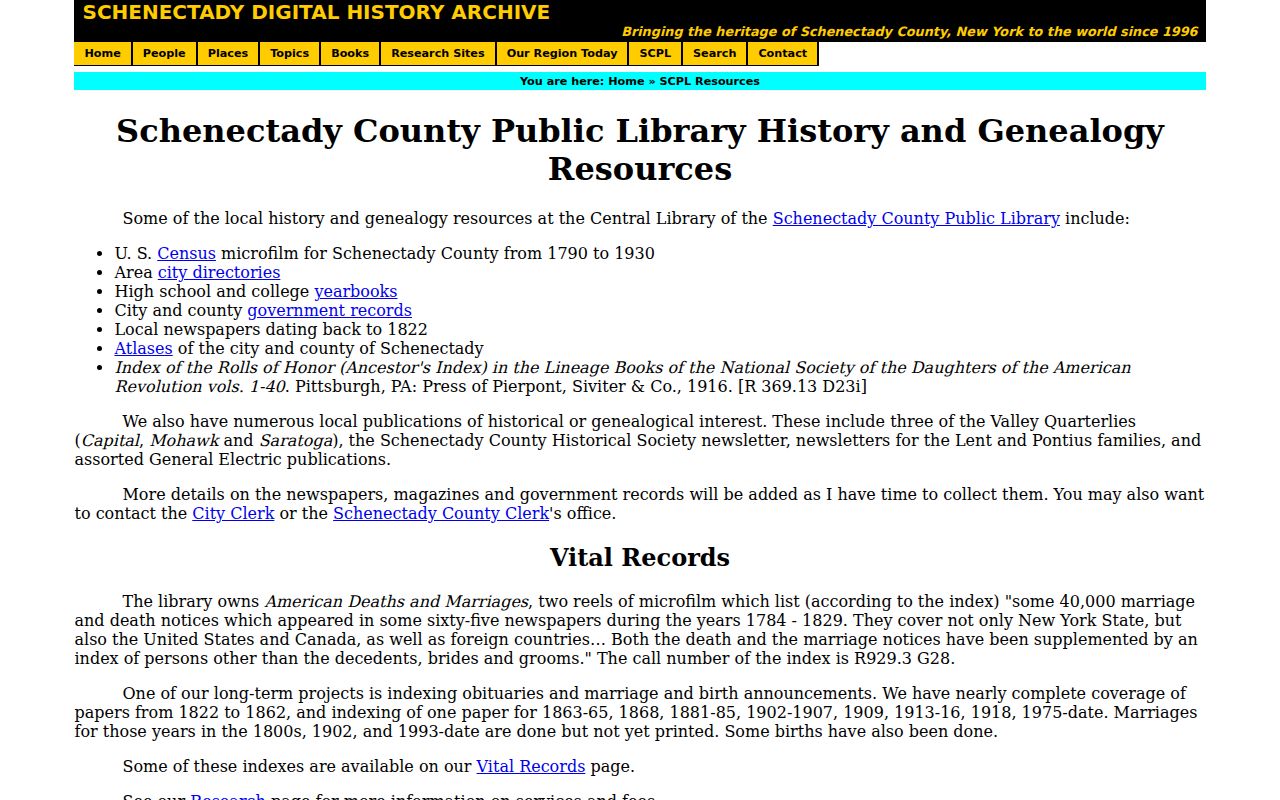
A yearbook or newspaper can help distinguish two people with the same name, but its own date and scope still need to be recorded.
Reading a Niskayuna City Directory Entry
Read the abbreviation key before interpreting any entry. The exact marks vary by edition, and not every Niskayuna city directory prints the same fields. A line normally identifies a person and gives some combination of household relationship, work, business, or address. The field is an index-style lead, not a certified record. When the name is common, use the address and directory year before linking it to a court, cemetery, or vital-record result.
| Name | The listed person or household name, often the first item to compare across editions. |
|---|---|
| Occupation or business | A work or business reference that can separate similar names, but may change over time. |
| Address | The printed street form for that edition; preserve it before normalizing a historic address. |
| Household notation | Relationship, boarding, widow, or other abbreviated notation when the volume provides it. |
| Section and scope | Whether the result came from alphabetical, occupation, business, or street arrangement, plus the place covered. |
- Criss-cross directory
- A reverse arrangement that groups entries by street or address rather than by a person’s name.
- Householder index
- An alphabetical list focused on the person recorded for a household, which may not name every person there.
- Abbreviation key
- The volume’s explanation of shorthand. Photograph or transcribe it with any line used as evidence.
Niskayuna City Directory Street Listings
Original directory street listings do not begin until 1930. Before that point, an address search can fail simply because the volume is alphabetical, occupational, business-arranged, or based on a volunteer street compilation. Search the name first, examine all parts of the edition, and compare a historic street form to a period map. A no-hit result in an 1860 volume is not meaningful until the structure of that specific volume has been checked.
The directory hub identifies the digitized historical material and explains the collection context.
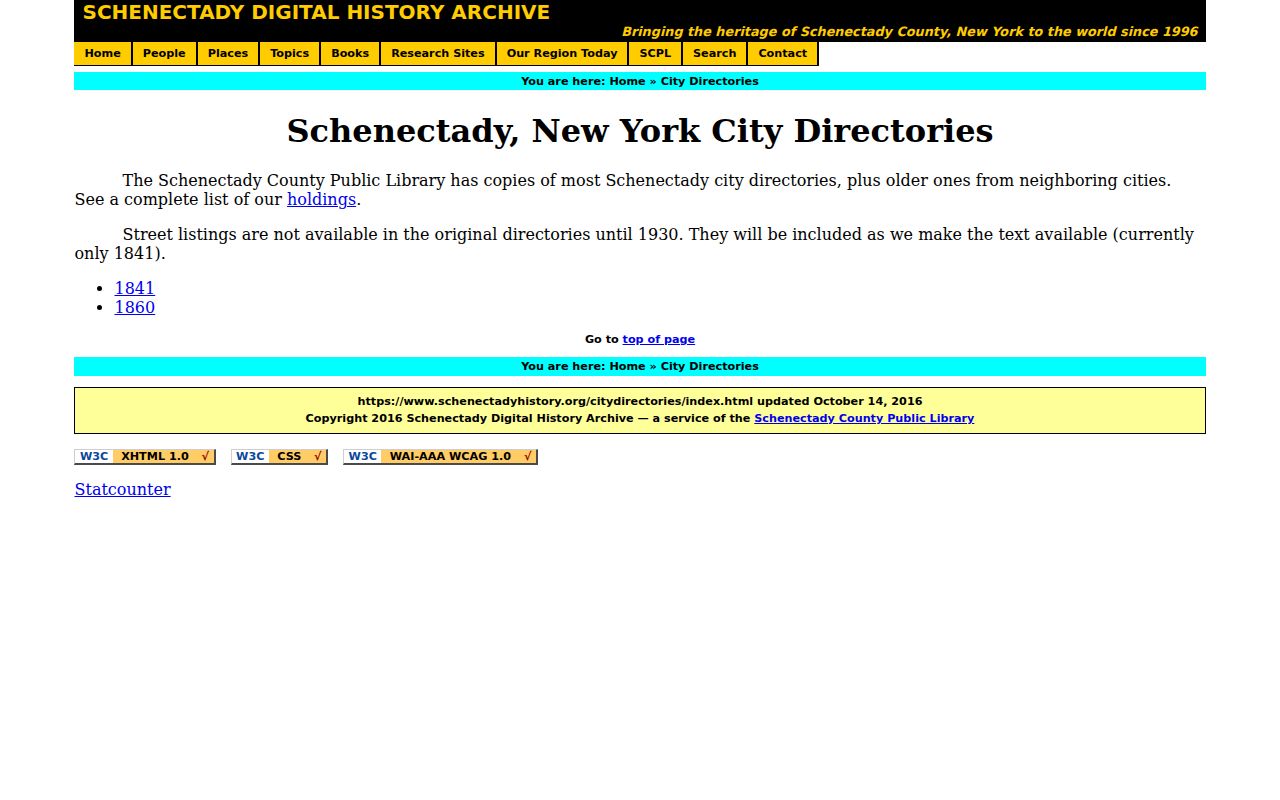
A street-ordered entry can give a useful neighborhood view, but modern parcel and address work belongs with the Niskayuna street directory lookup rather than a historical volume alone.
Note: Keep the original spelling and street form beside any modernized version used for a second search.
Niskayuna Historical Directory Research
The Schenectady County Historical Society collections provide a second route when the public library shelf is not enough. Its Grems-Doolittle Library holds genealogies, family histories, newspapers, yearbooks, wills, naturalization material, maps, photographs, family papers, school and church records, and oral histories. Search the collection catalog before the visit and name the desired year or subject when requesting help.
Grems-Doolittle requires an appointment at least two business days ahead. It is at 32 Washington Avenue in Schenectady, with research contact by phone at 518-374-0263 extension 3 or by email at librarian@schenectadyhistorical.org. The appointment rule is an access step, not a guarantee that a particular city directory will be on the shelf.
The Historical Society collections page explains the Grems-Doolittle Library and its appointment access.
The society’s indexes include an obituary index with more than 5,000 entries, a 1865 New York census index, school publications, cemetery material, and other local series that can test a directory finding. Jonathan Pearson Street Books from about 1870 and real-estate material from 1870-1880 can add a dated address clue. The county marriage index for 1908-1916 is another way to test a family connection without treating one city directory line as final proof.
Tracing Niskayuna City Directory Households
Trace a household in date order, not by jumping from one isolated name to a modern record. Start with the earliest confirmed directory appearance, preserve the exact printed form, and compare nearby editions. When an address changes, a census, atlas, deed, or obituary can help decide whether the person moved, died, changed work, or was simply left out. The House Histories Quick Research Guide specifically names directories, maps, tax material, wills, deeds, and mortgages as linked sources.
- Find the first reliable name or address entry and record its year, section, and geographic scope.
- Check the next available directory years, including the holdings gaps rather than treating them as no-entry years.
- Compare a move or occupation change with census, newspaper, map, or deed material from the same period.
- Use an obituary, cemetery, church, or family source to test a disappearance from the directory.
- Keep each source type separate in notes so a directory line is never treated as a vital or property record.
Niskayuna Directory Geography Before 1809
Older research has a county boundary issue. Schenectady County was established in 1809, and the house-history guide warns that earlier deeds and mortgages may be found through the Albany County Hall of Records. A Niskayuna historical identity can also appear under a Schenectady label in a directory or archive because the Town and City are distinct places with overlapping historical research paths. Do not turn a municipal label change into a claimed move without comparing the date, map, and underlying source.
The Niskayuna Digital History archive adds 1810 and 1820 census transcripts, maps, a chronology, historic buildings, and local source links. It is useful context for a city directory trail, especially when the directory predates original street listings.